A vane pump is the fixed-displacement hydraulic pump found on many conventional injection molding machines. A slotted rotor turns inside an oval cam ring, and the vanes sliding in its slots carry oil from the suction port to the pressure port. Common series are the Yuken PV2R and PV2R-pattern pumps, the Vickers V and VQ series, the Tokimec SQP and the 50T. On the drawing, it is the pump bolted to the bell housing on top of the oil tank.
How a vane pump works
The working parts form a cartridge (or pump core) inside the housing:
- the rotor, splined to the drive shaft, with radial slots;
- the vanes, flat blades that slide in and out of the slots;
- the cam ring, whose inner contour the vane tips follow;
- two side plates (port plates) with the suction and pressure openings.
As the rotor turns, centrifugal force and pressure oil fed under the vanes keep their tips against the cam ring. The space between two vanes grows as it passes the suction openings, so it fills with oil, then shrinks as it passes the pressure openings and pushes the oil out.
The pumps used on injection molding machines are balanced designs: the cam ring has two lobes, so there are two suction zones and two pressure zones opposite each other and the pressure loads on the shaft cancel out. A balanced pump cannot change its displacement, which is why these pumps are fixed displacement. Below the minimum speed in the pump data, the vanes may not extend properly and the pump delivers little or no oil.
Single and double vane pumps
A double pump has two cartridges on one shaft with a common suction and two outlets. Many fixed pump machines use it in a high-low circuit: both outlets deliver for fast movements, and the large one is unloaded to the tank when pressure builds, so the small one alone supplies hold and clamping pressure. Among the codes in our listing, the PV2R13, PV2R23, SQP32 and Vickers 3525V and 4535V are double pumps.
The vane pump series we supply
Our vane pump listing covers:
- Yuken PV2R, frame sizes 1 to 4 and the double versions, and Taixin PV2R pumps built to the same pattern;
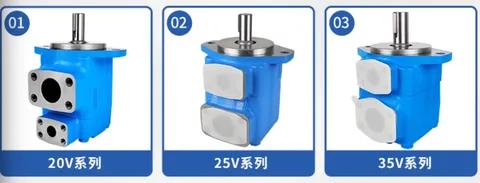
- Vickers 20V, 25V, 35V and 45V and their double versions, and the Vickers / Eaton VQ series;
- Tokimec SQP, sizes 2 to 4, the double SQP21 to SQP43 and the SQPS versions;
- the 50T series, with a small 19.9 mm shaft or a large 22.2 mm shaft, rated to 7 MPa.
They are listed for Haitian MA and Jupiter series and Chen Hsong JM series machines. Displacements range from about 6 to 237 cm³/rev and pressure ratings up to 21 MPa, depending on the model, so check the part page and the original pump's data.
Reading a vane pump model code
Take a Yuken code such as PV2R1-8-F-RAA-43:
- PV2R is the series;
- 1 is the frame size;
- 8 is the displacement in cm³ per revolution;
- F is flange mounting;
- R is the direction of rotation (clockwise, seen from the shaft end), and the letters after it give the port positions;
- 43 is the design number.
Other makers build their codes differently, so look them up in the maker's catalogue. When you order, copy the full code from the nameplate instead of decoding it.
Signs of a worn vane pump
- Movements slow down, especially at high pressure, as oil leaks between the vanes, cam ring and side plates.
- The pressure drops or fluctuates under load.
- A whine, rattle or vane chatter that gets louder over time.
- Higher oil temperature at the same cycle.
- Oil leaking at the shaft seal.
- No delivery after start-up: wrong direction of rotation, air trapped in the pump, or vanes stuck in their slots.
Why vane pumps wear
Dirty oil scores the cam ring and side plates and can break vanes. Cavitation, from a blocked suction filter, a low oil level or cold, thick oil, erodes the side plates. Air drawn in at the suction line or shaft seal makes the vanes chatter. Oil of the wrong viscosity either leaks too much or starves the pump at start-up; see hydraulic oil and the oil filter. A misaligned coupling loads the shaft bearing and the shaft seal.
Repair or replace
If the housing bore and the shaft are in good condition, many balanced vane pumps are repaired with a cartridge kit: rotor, vanes, cam ring and side plates as a matched set, fitted with a new shaft seal and O-rings. If the housing is scored or cracked, or the shaft is worn at the bearing or seal, replace the complete pump.
Fitting a replacement vane pump
- Check that the model code, direction of rotation, shaft, flange and port positions match the old pump. The 50T series shows why the shaft must be checked as well as the code: the same 50T model is listed with a 19.9 mm or a 22.2 mm shaft.
- Inspect the pump coupling and bell housing and fit a new coupling insert.
- Fill the pump with clean oil through a port before connecting it.
- Make sure the suction connection seals tightly, and open the suction valve if the tank has one.
- Check the direction of rotation, then run the pump unloaded until the air is out and the noise is steady.
- Change the filters, then check the pressures with a gauge against the machine manual.
What to send for a replacement quote
The full model code from the nameplate and the machine model. If the plate is unreadable, send photos of the pump, the shaft diameter and type, the flange, the port sizes and positions, the direction of rotation, and whether it is a single or double pump. For background, see hydraulic pump types and vane pump vs piston pump, then request a quote. The hydraulic system guide shows how the pump fits into the rest of the circuit.
Updated by the IMSPARES technical team.