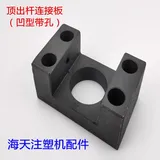
The ejector system of an injection molding machine pushes the molded part off the mold after the mold opens. The machine's side of it sits behind the moving platen: an ejector cylinder (on all-electric machines, a servo motor) moves a connecting plate, which drives ejector rods through holes in the moving platen. The rods push the mold's own ejector plate, and that plate carries the ejector pins that push the part. The drawing above shows both sides: items 1 to 5 belong to the machine, and item 6, the mold ejector plate and pins, belongs to the mold.
How ejection works in the cycle
- The mold opens. When cooling ends, the moving platen carries the moving mold half, with the part on its core, away from the fixed half.
- Ejector forward. At the set position, or during opening if the machine is set that way, the ejector cylinder pushes the connecting plate and the ejector rods forward.
- The mold ejects the part. The rods push the mold's ejector plate forward, and its pins, sleeves or blades push the part off the core. The machine can make one stroke or several to shake a part loose.
- Ejector back. The cylinder pulls the connecting plate back, helped on many machines by return springs. In the mold, the ejector plate comes back with the rods if they are coupled to it, or is returned by the mold's own springs and return pins if they are not.
- Mold close. The controller checks that the ejector is back, using a linear transducer, a proximity sensor or a limit switch depending on the machine, before it lets the mold close.
Machine side and mold side
| Part | Belongs to | What it does |
|---|---|---|
| Ejector cylinder (or servo motor) | Machine | Produces the ejector stroke and force |
| Connecting plate and pins | Machine | Joins the cylinder rod to the ejector rods and keeps them square |
| Return springs | Machine, and many molds | Push the plate back after ejection |
| Ejector rods | Machine | Carry the force through the moving platen to the mold |
| Ejector plate, pins, sleeves, return pins | Mold | Push the part off the core and return before the mold closes |
When a part ejects badly, the cause can be on either side, so check both.
The parts of the ejector
Ejector cylinder
A small double-acting hydraulic cylinder mounted on the back of the moving platen. Its rod drives the connecting plate forward to eject and back to retract, at the speed and force set on the controller. See the ejector cylinder guide and the auxiliary cylinders we supply.
Connecting plate and pins
A steel plate that joins the cylinder rod to all the ejector rods, so they move together. Guide pins through it keep it square as it moves. It is the machine's ejector plate, not to be confused with the one inside the mold: see ejector plate and our connecting plate and pin kits.
Return springs
Compression springs on the guide pins that push the connecting plate back after ejection, so the ejector rods are clear before the mold closes. Many molds have return springs of their own on the mold's ejector plate. See ejector return springs and our return springs.
Moving platen
The ejector rods pass through the center bore and the ejector holes of the moving platen to reach the mold. A bent rod or a burr in a hole makes them bind. See moving and stationary platens.
Ejector rods
Hardened steel rods, also called knock-out rods, screwed into the connecting plate. Their length decides where the mold's ejector plate stops at each end of the stroke, and all the rods used on one mold must be the same length so the plate moves square. See ejector rods and the ejector rods we supply.
Mold ejector plate and pins
These are part of the mold, not the machine. The mold's ejector plate and retainer plate hold the ejector pins; when the machine's rods push the plate, the pins push the part off the core. Pin wear, pin marks and broken pins are mold issues, but they are often caused or made worse by the machine's rods and settings: see ejector pins.
Ejector settings
The controller sets the ejector's forward and back positions, its speed and force in each direction, the delay after the mold opens, and the number of strokes. Some machines can hold the ejector forward for a robot, or start ejecting while the mold is still opening. Positions are read by a linear transducer on many current machines, and by proximity sensors or limit switches at set points on simpler ones. Match the settings to the mold: a stroke longer than the mold's ejector travel drives its plate into the stops, and too much speed or force marks or cracks the part.
Common problems and their symptoms
- Part sticks or is not fully ejected: stroke too short, rods too short, ejector force too low, or a mold problem such as poor draft or overpacking.
- Pin marks, white stress marks or cracked parts: ejection too fast or too forceful, too few or too small pins, or a mold plate pushed off square by rods of different lengths.
- Ejector does not return, or an ejector-not-back alarm: broken return springs, a sticking connecting plate, a bent rod, a hydraulic valve fault or a faulty position sensor. Never bypass this interlock: closing the mold with the ejector forward can crush the pins and damage the mold.
- Ejector creeps forward when it should stay back: internal leakage in the cylinder or in the valve.
- Oil on the platen or the mold: a leaking rod seal on the ejector cylinder, or a loose fitting.
- Bent or broken ejector rods: ejecting against a closed or blocked mold, a rod that has unscrewed, or side load from a tilted plate.
What to send for a replacement quote
- The machine brand, model and serial number.
- Which part you need: ejector cylinder, connecting plate, guide pins, return springs or ejector rods, and how many.
- The dimensions: for rods, length, diameter and the thread at each end; for springs, outside diameter, wire size and free length; for cylinders, bore, rod diameter, stroke and mounting.
- Photos of the old parts, and the OEM part number or nameplate data if you have them.
Request a quote with these details. Ejector pins and other mold components come from your mold maker or a mold component supplier.
Maintenance
- Keep the guide pins of the connecting plate and the ejector rods clean, and lubricate them as the manual specifies.
- Check that the ejector rods are tight in the connecting plate and all the same length, especially after a mold change.
- Check the return springs for broken coils and loss of length.
- Watch for oil at the ejector cylinder's rod seal, and for an ejector that creeps or has slowed down.
- Set the ejector stroke, speed and force for each mold, and keep the settings with the mold's setting sheet.
Updated by the IMSPARES technical team.