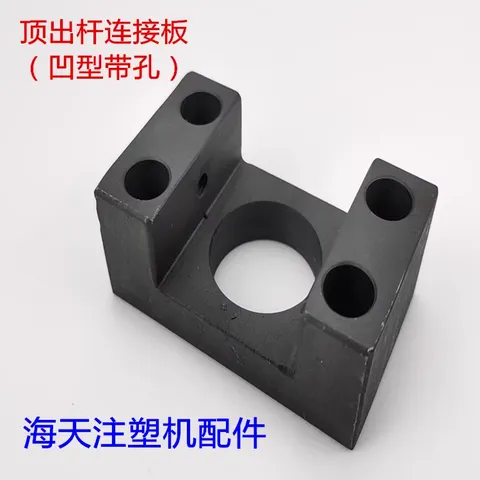
In injection molding, "ejector plate" can mean two different plates. On the machine, the ejector connecting plate sits behind the moving platen and joins the ejector cylinder's rod to the ejector rods. In the mold, the ejector plate and its retainer plate carry the ejector pins. The machine's plate drives the mold's plate through the ejector rods: when the connecting plate moves forward, the rods push the mold's ejector plate, and its pins push the part off the core. This page covers both, starting with the machine's connecting plate, the item highlighted in the drawing.
The machine's connecting plate
The connecting plate is a steel plate fixed to the end of the ejector cylinder's rod. The ejector rods screw into it, so the cylinder moves all the rods together. Guide pins pass through it, and in the drawing the return springs sit on these pins between the plate and the moving platen.
The connecting plate has three jobs:
- to share the cylinder's force between the rods in use;
- to keep the rods parallel to each other and square to the platen, guided by its pins;
- to stop all the rods at the same position at both ends of the stroke.
The connecting plate and pin kit we supply for Haitian MA60–160T and MA200T machines includes a recessed connecting plate with holes, a connecting plate with holes, a solid connecting plate and a pin, sold individually or as a 4-piece set, in alloy steel with a black oxide or nickel finish.
The mold's ejector plate
Inside the mold, behind the core, two plates are bolted together:
- the ejector retainer plate, which holds the heads of the ejector pins, sleeves and blades in counterbored holes;
- the ejector plate behind it, which closes the counterbores and takes the push of the machine's ejector rods.
The two plates move in the space between the support plate and the mold's ejector-side clamping plate, between the spacer blocks. Many molds guide them with their own ejector guide pins and bushings, and rest them on stop buttons, small pads that give a clean, defined back position. Return pins fixed in the plates reach the parting line, so the fixed half pushes the plates back when the mold closes, and springs often return them earlier. The pins themselves are covered on the ejector pins page.
How the two plates work together
- The ejector cylinder pushes the machine's connecting plate forward.
- The ejector rods carry the push through the moving platen and the mold's clamping plate to the mold's ejector plate.
- The mold's plate moves forward and the pins push the part.
- On the way back, the connecting plate retracts, helped by the return springs. The mold's plate follows if the rods are coupled to it, or is returned by its own springs and return pins if they are not: see ejector rods.
If either plate tilts, the pins are pushed sideways in their holes, which leads to galling, binding and broken pins.
Signs of wear or damage
On the machine's connecting plate:
- worn or scored guide pins and guide holes, which let the plate tilt;
- damaged threads where the ejector rods and the cylinder rod screw in, or rods that keep coming loose;
- a bent or cracked plate after ejecting against a blocked mold;
- broken or tired return springs, so the plate returns slowly or not fully.
In the mold:
- pins binding or breaking, often on one side of the plate;
- a plate that does not return fully, so the pins stand proud and leave marks, or are crushed when the mold closes;
- dirt, plastic or water under the plate or on the stop buttons;
- worn ejector guide bushings.
Inspecting and replacing the connecting plate
- Retract the ejector, switch off and lock out the machine, and release the hydraulic pressure.
- Remove the ejector rods, then unscrew or unbolt the plate from the cylinder rod.
- Take the plate off with its guide pins and springs, noting how the springs and any spacers sit.
- Check the plate for flatness and cracks, the guide holes and pins for wear, and all the threads.
- Fit the new plate and pins, refit the springs, tighten the cylinder rod connection and refit the rods.
- Run the ejector slowly without a mold, then with the mold, and check that the plate moves smoothly and stops square.
What to send for a replacement quote
Send the machine brand, model and clamping force; which plate you need (recessed with holes, with holes, or solid), or a photo of the old one; the plate's outside dimensions and thickness; the positions and thread sizes of the holes for the ejector rods and the cylinder rod; and the diameter and length of the guide pins. Request a quote, and see the ejector guide for the whole system.
Updated by the IMSPARES technical team.