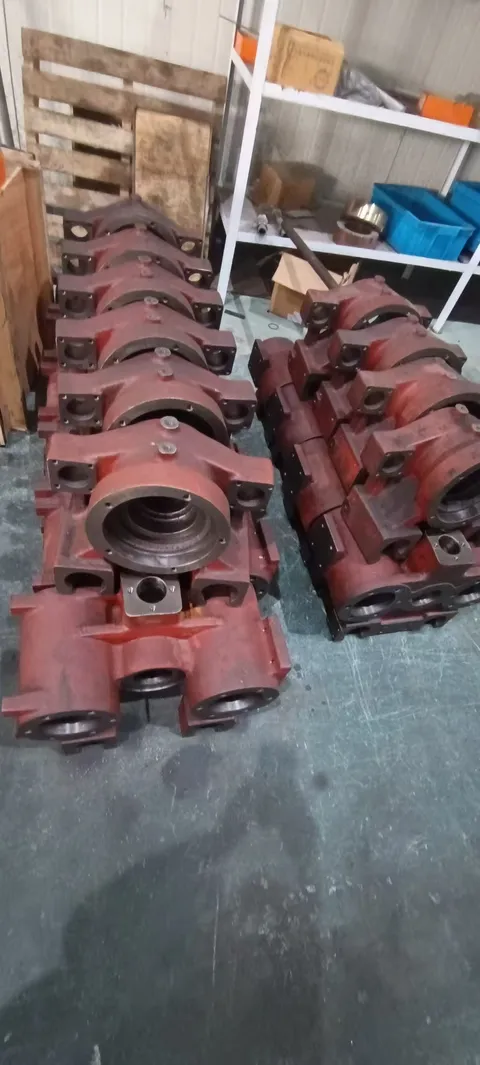
The moving platen is the platen that travels along the tie bars of an injection molding machine to open and close the mold. It carries the moving half of the mold and, on its back, the ejector. It closes against the stationary platen, the fixed plate at the injection side that carries the other mold half and lines it up with the nozzle. On a toggle machine a third plate, the rear platen, anchors the toggle. All three are heavy iron castings; the drawing shows one from the front and from the side.
Stationary, moving and rear platens compared
| Stationary platen | Moving platen | Rear platen | |
|---|---|---|---|
| Position | Injection side, fixed to the machine frame | Between the other two | Behind the toggle |
| Moves | No | Every cycle, over the opening stroke | Only during mold height adjustment |
| Carries | Fixed mold half and locating ring | Moving mold half and ejector | Toggle and clamping cylinder |
| On the tie bars | Held by the tie bar nuts | Slides on bushings | Positioned by the adjusting nuts |
How the moving platen moves and is supported
The toggle links are pinned to lugs on the back of the moving platen. When the clamping cylinder straightens the toggle, the platen slides forward on its tie bar bushings; when the toggle folds, it slides back. The moving platen is heavy, and the moving mold half, hanging on its front face, adds to the load. How that weight is carried depends on the machine:
- On many smaller machines the tie bar bushings carry the platen.
- Larger machines, and many newer designs, add a support under the platen, such as slide shoes or a linear guide on the machine frame, often adjustable in height, so the bushings mainly guide and the weight is taken off the tie bars.
Either way the platen must move straight and stay square to the tie bars. A platen that drops or tilts loses parallelism with the stationary platen, and the mold closes unevenly. The tie bar bushings page explains how the bushings wear and how to measure them.
The stationary platen
The stationary platen is bolted to the machine frame and fixed to the front ends of the tie bars by the tie bar nuts. Its center bore takes the mold's locating ring and lets the nozzle through to the sprue bushing. During clamping it is pressed by the mold in the middle and held by the tie bars at the corners, so it bends slightly; its thickness and ribbing are designed to keep that bending small.
Signs of wear or damage
- The moving platen drops at the mold face or rocks when pushed: worn tie bar bushings, or a worn or badly set platen support.
- Score marks on the tie bars or on the support ways.
- Fast wear of the mold's guide pins and bushings, or mold halves that knock as they meet.
- Dents, burrs or worn patches on the mold face, stripped tapped holes and cracked T-slot lips.
- Ejector rods that bind in the platen holes.
- Cracks, most often at the tie bar bores, the toggle lugs or around the center bore.
Common causes are missed lubrication of the bushings and supports, heavy molds, small molds clamped at high force, overloads such as closing on a part left in the mold, and toggle wear that pushes the platen off line.
Inspecting the platens
- Clean the mold faces and look for dents, burrs and cracks, paying attention to the tie bar bores, toggle lugs and center bore. Dye penetrant testing shows fine cracks that are hard to see.
- Check the mold face for flatness with a precision straight edge and feeler gauges.
- Measure the vertical play of the moving platen at each corner by lifting it slightly with a jack while a dial indicator reads the movement.
- Check the platen support: wear plates, adjusting screws and lubrication.
- Measure the parallelism between the moving and stationary platens.
Compare every reading with the machine manual. Light damage to the mold face can be dressed with a honing stone; anything more, and every crack, needs the manufacturer or a specialist.
Replacing a platen
Replacing a platen is a major job. The mold, the toggle or clamp parts and usually the tie bars have to come off, and the new platen has to be aligned with the others. Plan it with the manufacturer's procedure and suitable lifting gear, and measure parallelism and tie bar loading before production restarts. Our machine platens come in stationary, moving and rear versions in gray cast iron or ductile iron, machined with T-slots and tie bar holes, and are listed for Haitian MA, MA II and MA III series machines.
What to send for a replacement quote
Send the machine brand, model and serial number; which platen you need; photos of the whole platen and of any damage; the main dimensions (face size, thickness, tie bar bore diameter and spacing, T-slot pattern, center bore and ejector holes); and the OEM part number or drawing if you have one. Request a quote, and see the platens guide for the other platen features.
Updated by the IMSPARES technical team.