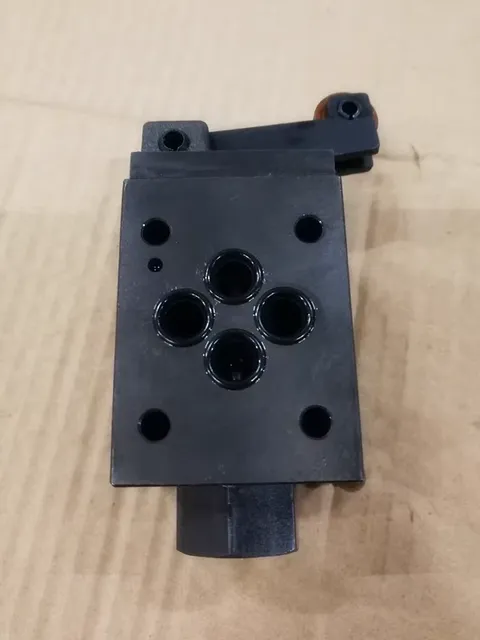
A proportional valve on an injection molding machine sets pressure or flow in proportion to an electrical signal from the controller. On many machines with a fixed pump, a combined proportional pressure and flow valve (often called a P/Q valve) is what turns the speeds and pressures set on the screen into oil: injection speed and pressure, holding pressure, clamp and ejector speeds. On the drawing it is the valve on the right of the manifold top, with its coil and plug standing up from the body.
How a proportional valve works
An on/off solenoid either pushes with full force or not at all. A proportional solenoid produces a force that follows the current through its coil, so the valve can be set anywhere between closed and fully open, or between minimum and maximum pressure.
The amplifier
The controller sends a command signal; an amplifier turns it into a regulated coil current. The amplifier is either a card in the electrical cabinet or electronics built onto the valve. It also sets the ramp times, the minimum and maximum current and a small dither (a fast oscillation of the current that keeps the spool or poppet from sticking).
Pressure section
The pressure part is a pilot-operated relief valve whose pilot poppet is held by the proportional solenoid instead of a spring. The higher the current, the higher the pressure at which the valve opens and sends oil to the tank, so the system pressure follows the command. A separate proportional pilot relief valve works the same way: connected to the vent port of a main relief valve, it sets the pressure at which the main valve opens.
Flow section
The flow part is a throttle whose opening follows the command, combined with a pressure compensator that keeps the pressure drop across the throttle constant. The flow then depends on the opening and not on the load. On a fixed pump machine, the oil the actuator does not need goes back to the tank through the valve.
Other proportional valves
Some machines also use proportional directional valves, which set both the direction and the speed of a movement, and a proportional relief valve for screw back pressure. On variable pump machines the proportional control may sit on the pump, and on servo pump machines the servo drive takes over the pressure and flow control.
The proportional pressure/flow valve we supply is listed with the model EDG-01-A-45, the type designation of a proportional pilot relief valve. It is a 24 V DC valve rated to 35 MPa and works with a matching proportional amplifier.
Calibration
The relation between the command and the actual pressure or flow is never exactly a straight line, and it differs a little from one valve to the next. The machine controller therefore holds a calibration table (often called linearization) for pressure and for flow. After a proportional valve or its amplifier is replaced, run the calibration routine in the machine manual, and compare the actual pressure with a gauge at several setpoints. Check the amplifier's minimum and maximum current settings at the same time.
Signs of a faulty proportional valve
- Pressure or speed does not follow the setpoint, or stays the same whatever the setting.
- Pressure that jumps, oscillates or overshoots.
- Slow response at the start of a movement.
- No pressure at all, or pressure stuck high.
- Injection speed or fill time that varies from shot to shot while the settings stay the same.
Why proportional valves fail
- Contamination. The pilot stage has small orifices and close clearances that dirt and varnish block or wear. Proportional valves are among the most sensitive parts of the circuit to dirty oil; see the oil filter and our article on hydraulic oil problems.
- Electrical faults. An open or short-circuited coil, a damaged cable or connector, or a faulty amplifier.
- Air trapped in the solenoid or pilot chamber; some valves have a bleed screw for it.
- Wear of the spool, poppet and seat after long service.
Testing a proportional valve
- Fit a calibrated gauge and compare the actual pressure with the setpoint at several values.
- With the power off, measure the coil resistance and compare it with the valve data.
- With the machine running, measure the coil current, or use the amplifier's test points, and check that it changes with the command.
- Check the amplifier's supply voltage and its input signal from the controller.
- Bleed the valve if it has a bleed screw.
- If the electrical side is correct but the hydraulic response is wrong, clean or replace the valve, then flush the oil and change the filters to remove the dirt that caused it.
The troubleshooting hydraulic pressure loss guide shows where the proportional valve fits in the order of tests.
What to send for a replacement quote
The model code from the valve nameplate, the amplifier model (card or on-board), the coil voltage and resistance, the connector type, and photos of the valve, its nameplate and the valve manifold face it mounts on. Add the machine model and serial number, then request a quote. The hydraulic system guide shows how it works with the pump and the other valves.
Updated by the IMSPARES technical team.