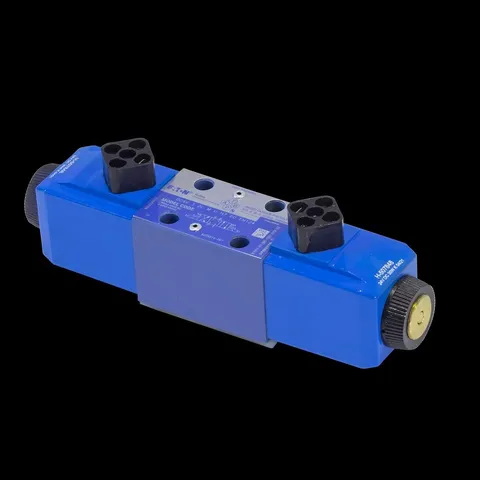
A solenoid directional valve switches the oil of an injection molding machine between the two sides of a cylinder or hydraulic motor, so it starts, stops and reverses a movement. A spool slides in a bore in the valve body. When the controller energizes one of the solenoids, the spool shifts and connects the pump to one work port and the other work port to the tank. On the drawing, the directional valve is the valve bolted on top of the manifold block with a solenoid at each end.
How a solenoid directional valve works
The valve body has four main ports: P from the pump, T to the tank, and the work ports A and B to the actuator. The spool has lands that open or close the passages between them.
- A 4/3 valve has three positions. Springs center the spool when both solenoids are off; energizing solenoid a or b shifts it one way or the other, to send oil to A or to B.
- A 4/2 valve has two positions: one solenoid with a spring return, or two solenoids with a detent that holds the last position.
The center position decides what the actuator and pump do when the valve is off. With all ports blocked, the cylinder is held and the pump is cut off from it; with P connected to T, the pump unloads to the tank; with A and B connected to T, the cylinder floats. The spool type is part of the valve's model code, and a replacement must have the same one.
Our directional control valve uses wet-pin solenoids: the armature runs in oil inside a sealed tube, so there is no seal on the push pin to leak, and the coil slides over the tube. Its coils are available for 24 V DC or 220 V AC. Most solenoids have a manual override pin in the end cap that shifts the spool by hand for testing.
Mounting sizes and high-flow valves
Directional valves mount on the valve manifold through standard ISO 4401 interfaces:
| Interface | Also called | Usual role |
|---|---|---|
| Cetop 3 | D03, NG6 | Smaller flows and the pilot stage of larger valves |
| Cetop 5 | D05, NG10 | Medium flows |
| Cetop 7 | D07, NG16 | Larger flows, usually pilot-operated |
Our directional control valve comes in Cetop 3, 5 and 7, listed for flows up to 60, 80 and 120 L/min respectively, with 2-position and 3-position spools and a 31.5 MPa pressure rating. For the clamp and injection circuits of large-tonnage machines, a high-flow solenoid valve is used: a small solenoid valve on top shifts the large main spool with pilot oil. See the high-flow solenoid valve we supply; on the drawing it sits to the right of the directional valve.
Signs of a faulty directional valve
- A movement does not happen in one direction, or in either.
- A movement does not stop, because the spool stays shifted.
- A movement is slow or weak: the spool shifts only part way, or oil leaks across worn spool lands.
- A cylinder drifts with the valve in its center position. A spool valve always leaks a little; where a cylinder must hold, the circuit uses a pilot-operated check valve or a cartridge valve.
- A coil that is very hot, smells burnt or reads open circuit.
- An AC solenoid that hums loudly.
- Oil leaking between the valve and the manifold, or at the solenoid tube.
Why directional valves fail
- Dirt and varnish in the oil make the spool stick in its bore.
- Coil failures from the wrong voltage, overheating, a stuck spool on an AC coil (an AC solenoid draws a high current until its armature completes its stroke), or water and oil in the connector.
- Wear of the spool and bore, which increases internal leakage.
- Hardened O-rings on the mounting face, from heat and age.
- Over-tightened mounting bolts, which can distort the body and make the spool stick.
Testing and replacing a directional valve
- Check the controller output for the movement, and look at the LED in the valve plug if it has one. Measure the voltage at the connector while the movement is commanded.
- With the power off, measure the coil resistance and compare it with a good coil of the same type.
- With the machine in manual mode and everyone clear of moving parts, check whether the spool moves with the manual override.
- If a valve with the same full model code is fitted elsewhere on the machine, swapping the two confirms whether the fault moves with the valve.
- To replace it, lock out the machine, relieve the pressure (including the accumulator), clean around the valve, and remove it with a tray under it to catch the oil. Cover the manifold ports at once.
- Check that the new valve has the same interface, spool type, voltage and connector. Fit new O-rings, clean the mounting face, and tighten the bolts evenly to the torque in the machine manual.
The hydraulic circuit page explains how to use the action table to find which valve drives a movement.
What to send for a replacement quote
The model code from the valve nameplate (it gives the size, spool type, voltage and design), the voltage printed on the coil, the connector type, and photos of the valve and its nameplate. For a pilot-operated valve, include the model code of the pilot valve on top. Add the machine model and serial number, then request a quote. For the other valves and parts of the circuit, see the hydraulic system guide.
Updated by the IMSPARES technical team.