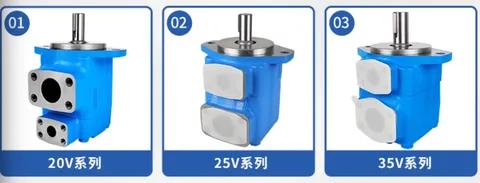
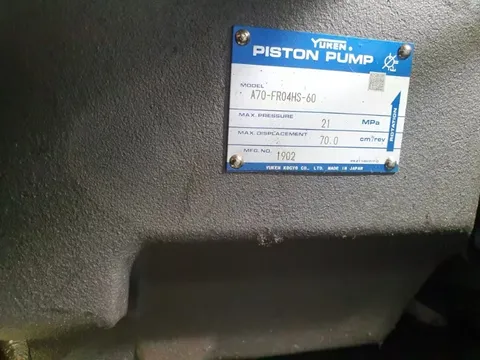
The hydraulic pump of an injection molding machine turns the rotation of the electric motor into the flow of oil that powers every movement. Three types are used: vane pumps, axial piston pumps and gear pumps. The pump sits on the oil tank, joined to the motor by a bell housing and coupling, and it is identified by the model code on its nameplate.
How a hydraulic pump works
All three types are positive-displacement pumps. Chambers inside the pump open on the suction side, fill with oil, close, and are emptied on the pressure side. The volume delivered per revolution is the displacement, usually given in cm³/rev, so the flow is the displacement multiplied by the speed, less the oil that leaks inside the pump.
The pump does not create pressure by itself. Pressure rises when the oil meets resistance at the valves and cylinders, up to the limit set by the relief valve, the pump's own control or the servo drive. That is why a worn pump shows up first as lost flow: oil leaks back inside the pump instead of going to the circuit, and the leak grows as the pressure rises.
Fixed and variable displacement
- A fixed-displacement pump delivers the same volume every revolution. At constant motor speed it delivers constant flow, and valves decide how much reaches the actuators; the rest returns to the tank. Driven by a servo motor, its flow follows the motor speed instead.
- A variable-displacement pump can change its displacement while it runs. On injection molding machines this is the axial piston pump, whose swashplate angle sets the flow and whose control reduces it when the set pressure is reached.
Pump types compared
| Vane pump | Axial piston pump | Gear pump | |
|---|---|---|---|
| Displacement on injection molding machines | Fixed | Usually variable | Fixed |
| Typical use | Fixed pump machines, often as double pumps | Machines with a variable pump control | Servo pump systems, some smaller machines |
| Sensitivity to dirty oil | Moderate | High | Lower |
| Repair | Cartridge kit (rotor, vanes, cam ring, side plates) | Rebuild of the rotating group and control | Small pumps usually replaced; larger internal gear pumps can be overhauled |
Vane pump
A slotted rotor turns inside an oval cam ring and its sliding vanes carry the oil around. Fixed vane pumps such as the PV2R, Vickers V and VQ, SQP and 50T series were for a long time the standard pump on conventional machines. See the vane pump page and the vane pumps we supply.
Piston pump
Pistons in a rotating cylinder block stroke against a tilted swashplate; changing the angle changes the flow. Variable piston pumps waste less energy than a fixed pump with valves, but need cleaner oil. See the piston pump page and the piston pumps we supply.
Gear pump
Meshing gears carry the oil from suction to outlet: two equal gears side by side in an external gear pump, or a small gear driving a ring gear in an internal gear pump. Internal gear pumps run quietly with a smooth flow and are a common choice for servo pump systems. See the gear pump page and the gear pump we supply.
For a direct comparison of the two most common types, read vane pump vs piston pump.
Signs of a failing pump
- Movements slower than before at the same speed settings.
- Pressure that does not reach the setpoint, or falls under load.
- More noise: a whine, a rattle or a growl that was not there before.
- The pump body and the oil running hotter than usual.
- Oil leaking at the shaft seal.
- Metal particles in the suction filter or on the drain plug magnet.
Before blaming the pump, rule out the suction side, the relief valve and the coupling, which cause the same symptoms. Our guide to troubleshooting hydraulic pressure loss explains the order of tests.
Why hydraulic pumps fail
- Dirty oil. Particles wear the close-fitting surfaces that seal the pump chambers.
- Cavitation. A blocked suction filter, a low oil level, a partly closed suction valve or cold, thick oil leaves the pump short of oil. Vapor bubbles collapse inside it and erode the metal.
- Air. A leak in the suction line or a worn shaft seal lets air in; the oil foams and the pump runs noisy and rough.
- Misalignment. A worn coupling or bell housing loads the shaft and bearings.
- Start-up damage. Running a new pump dry, or the wrong way round, damages it within a short time.
- Overheated or wrong oil. Oil that is too thin leaks more inside the pump; oil that is too thick at start-up starves it. See hydraulic oil.
Identifying and replacing a pump
- Read and photograph the model code on the nameplate. It identifies the series, size, mounting, direction of rotation and control.
- If the plate is unreadable, record the shaft (keyed or splined, its diameter), the flange (2-bolt or 4-bolt, pilot diameter), the port sizes and positions, and the direction of rotation.
- Before fitting the new pump, inspect the pump coupling and bell housing and replace the coupling insert.
- Fill the pump with clean oil; a piston pump's case must be filled through its drain port.
- Open the suction valve, check the direction of rotation, and start the pump unloaded until the air is out and the noise is steady.
- Change the filters, then check the pressure settings with a gauge against the values in the machine manual.
What to send for a replacement quote
The full model code from the pump nameplate, the machine brand, model and serial number, and photos of the pump, its nameplate, shaft, flange and ports. If the machine has a double pump or more than one pump unit, say which one you need. Request a quote with these details, or see how the pump fits into the hydraulic power unit. The hydraulic system guide shows where the pump sits in the circuit.
Updated by the IMSPARES technical team.