The injection molding machine barrel is the thick-walled steel tube that the screw turns in. It holds the plastic while it melts, carries the heater bands that bring it to processing temperature, and withstands the full injection pressure on every shot. At the rear it has the feed opening under the hopper; at the front it is closed by the barrel head (front flange), which holds the nozzle. Its bore and the screw flights wear against each other, and the clearance between them decides how well the screw can hold the shot.
The barrel is item 3 in the drawing. For how it works with the screw and the other parts of the plasticizing unit, see the barrel and screw guide.
How an injection molding machine barrel is built
- Tube. Alloy steel, with a bore ground or honed to a close fit around the screw flights. The small clearance is what lets the screw build pressure and push the melt forward instead of letting it slip back.
- Feed opening. A port in the top of the barrel at the rear, under the feed throat. The pellets drop through it onto the feed zone of the screw.
- Mounting. The rear end is fixed to the injection unit housing. The way it is held (a flange, a nut or a clamp) varies by machine.
- Thermocouple holes. Drilled into the barrel wall, one for each heating zone, so the thermocouple measures the steel close to the melt.
- Front face. A machined face, on most machines with tapped holes for the bolts of the barrel head.
- Heater bands and cover. Bands clamped around the outside in zones, usually under a sheet-metal cover that protects operators from the hot surface.
The bore surface
Standard barrels have a nitrided bore: the steel is hardened to a shallow depth by nitriding. Bimetallic barrels have a layer of wear-resistant alloy cast and bonded inside the bore, which lasts much longer with glass-filled, mineral-filled and flame-retardant plastics. The bimetallic barrel guide explains how the two compare.
Barrel zones
The barrel is heated in several zones, usually called rear (or feed), middle and front, with the nozzle as a separate zone. Each zone has one or more heater bands and its own thermocouple, and the controller holds each zone at its set point. Many materials run with a temperature profile that rises from the feed end to the front, but the material supplier's data sheet gives the recommended settings.
In production, much of the heat that melts the plastic is shear heat from the turning screw rather than heat from the bands, so a zone's actual temperature can run above its set point at high screw speeds or back pressures. The barrel temperature zones guide covers zone settings and the heater bands and thermocouples that control them.
The barrel's heating zones are not the same as the screw zones (feed, compression, metering): those are set by the shape of the screw.
Barrel wear and damage
A worn barrel shows the same symptoms as a worn screw: an unstable cushion, longer recovery, short shots and black specks. The damage behind them is usually one of these:
- Even bore wear from abrasive fillers, which opens the clearance all around.
- One-sided wear, which points to misalignment between the barrel and the screw drive, or to a bent screw.
- Local damage at one spot, from a hot spot, a piece of foreign metal or corrosion.
- Corrosion pitting from plastics or additives that release corrosive gases when they overheat.
- Damaged front face or bolt threads, which makes the barrel head leak.
- Cracks, which are rare and can follow injecting at high pressure on plastic that was not fully melted.
Inspecting and measuring the barrel
- Pull the screw while the barrel is at temperature (see how to remove the screw).
- Clean the bore while it is warm, with brass brushes and cotton rags on a rod, until the rags come out clean.
- Inspect the bore with a light for scoring, pitting and uneven polish, and check the front face and bolt threads.
- Once the barrel has cooled, measure the bore with a bore gauge at several positions along its length, and in two directions at each position to find ovality.
- Compare the readings with the nominal bore from the machine documentation, and with the screw flight diameters.
Our guide to measuring barrel and screw wear explains how to read the results, and when to replace the barrel covers the decision. If the barrel is worn, a new screw alone will not restore the clearance, so the barrel and screw are normally replaced together.
What to send for a replacement barrel
- The machine brand and model, the injection unit size and the screw diameter.
- The plastics you run and any fillers, and whether the old barrel is nitrided or bimetallic.
- The overall length, outside diameter and bore, and the position and size of the feed opening.
- The mounting at the rear end and the bolt pattern on the front face.
- The positions and thread size of the thermocouple holes.
- Photos of the whole barrel and both ends, and the OEM part number or a drawing if you have one.
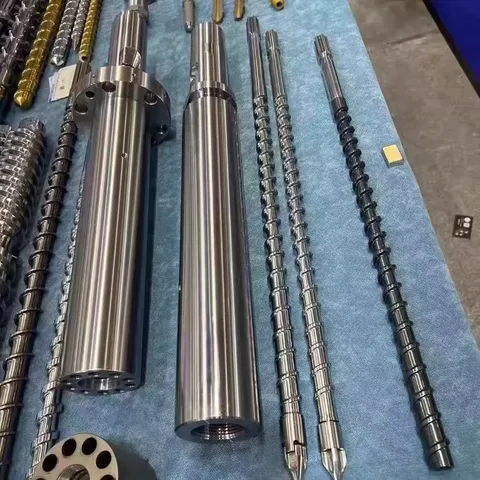
The barrel assemblies we supply are shown below. Request a quote with the details above.
Updated by the IMSPARES technical team.