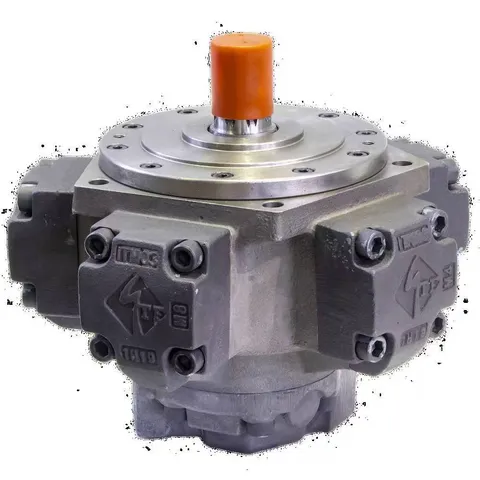
The plasticizing motor of a hydraulic injection molding machine is the low-speed, high-torque hydraulic motor that turns the screw during screw recovery. It is also called the screw drive motor, the hydraulic screw motor or the pre-plasticizing motor. On many machines it is a radial piston motor mounted at the back of the injection unit, with its shaft coupled to the screw by a spline or a key. The oil flow into the motor sets the screw speed, and the oil pressure sets the torque it can deliver. The drawing shows it as item 5, at the back of the injection unit, fed by the hydraulic power unit.
Where the plasticizing motor sits
The motor sits on the axis of the screw, behind the barrel. On many twin-cylinder injection units it is mounted on the moving plate that slides on the guide columns; on in-line units it is mounted behind the injection cylinder. Its shaft drives the screw through a drive sleeve or coupling that allows the screw to be removed. The motor moves forward and back with the screw on every shot, so its hoses must be flexible and in good condition. See the injection unit guide for how it fits in the cycle.
How it works
In a common design of radial piston motor, pistons are arranged like spokes around an eccentric shaft. A distributor sends pressurized oil to each piston in turn, the pistons push on the eccentric, and the shaft turns. This gives high torque at low speed, which is what a screw needs, without a gearbox.
Two figures describe a hydraulic motor:
- Displacement, the oil volume per revolution. For a given flow, a larger displacement turns slower; for a given pressure, it gives more torque.
- Maximum pressure, which sets the highest torque it can deliver.
The machine sets the screw speed by controlling the oil flow, with a proportional valve or a servo pump, and limits the torque with pressure. Many machines measure the screw speed with a sensor on the drive; see proximity sensor. Back pressure during recovery is held by the injection cylinder, not the motor; see back pressure.
Types of screw drive
- Radial piston motors. A common choice on hydraulic machines. The hydraulic plasticizing motor we supply is an NHM series radial piston motor, from NHM1 to NHM31 in displacement, with flat key or spline shafts in several diameters. Its part data lists a maximum pressure of 17.5 MPa and a speed range of 5 to 300 rpm.
- Orbital motors. Compact gerotor-type motors used on some smaller machines.
- Servo-electric drive. Electric and some hybrid machines turn the screw with a servo motor, directly or through a belt; see servo motor.
Signs of a worn or failing motor
- The screw turns slower than its set speed, or the speed drops when the load rises.
- Screw rotation is uneven or pulsing, or the motor knocks.
- Recovery time increases while the screw speed reading falls.
- The motor stalls on material that it used to handle at the same temperatures.
- Oil leaks at the shaft seal or between the housing parts.
- The motor or the oil returning from it runs hotter than usual.
- Play or a clunk when rotation starts, from a worn shaft spline, key or drive sleeve.
- The screw does not turn at all: check the valve, its signal and the supply before suspecting the motor.
Internal leakage is the usual wear mode: oil passes the pistons and the distributor without doing work, so the motor turns slower for the same flow and makes heat.
Causes of failure
- Dirty oil wears the pistons, the distributor and the bearings. See hydraulic oil problems.
- Hot oil thins the oil film and ages the seals.
- Cold starts. Turning the screw before the barrel has soaked loads the motor and the screw heavily.
- Restricted drain line. If the motor has a case drain, a blocked or kinked drain line raises the pressure in the housing and can push out the shaft seal.
- Worn drive coupling or misalignment, which loads the shaft and its bearing.
Slow recovery: motor or screw?
Compare the screw speed reading with the set speed during recovery:
- Speed normal, recovery slow: the motor is doing its job. Look at the screw and barrel for wear and at the barrel temperature zones.
- Speed low: check the hydraulic supply, the pressure reached during recovery and the flow valve; then the motor's internal leakage, which a hydraulic technician can measure at the drain line.
Replacing the motor
- Retract the screw drive, switch off the pump, release hydraulic pressure and lock off the machine.
- Label every hose and port, then disconnect them and cap the openings to keep dirt out.
- Support the motor before removing its mounting bolts: these motors are heavy.
- Remove the motor from its drive sleeve and check the spline or key and the sleeve for wear. Replace a worn sleeve with the motor.
- Fit a motor with the same displacement, shaft, flange and ports. If it has a case drain, fill the housing with clean hydraulic oil before starting, as the motor maker specifies.
- Reconnect the hoses, start at low screw speed, check for leaks and noise, then check the screw speed against its setting.
What to send for a replacement quote
- The full model from the motor's nameplate, for example an NHM series code with its displacement.
- The shaft type (flat key or spline) and diameter.
- The mounting flange and the port and drain sizes.
- The machine brand and model, and photos of the motor and its nameplate.
The NHM motors we supply are listed for Haitian MA series, Yizumi A5 series and Chen Hsong JM series machines; see the pumps and motors category, then request a quote.
Updated by the IMSPARES technical team.