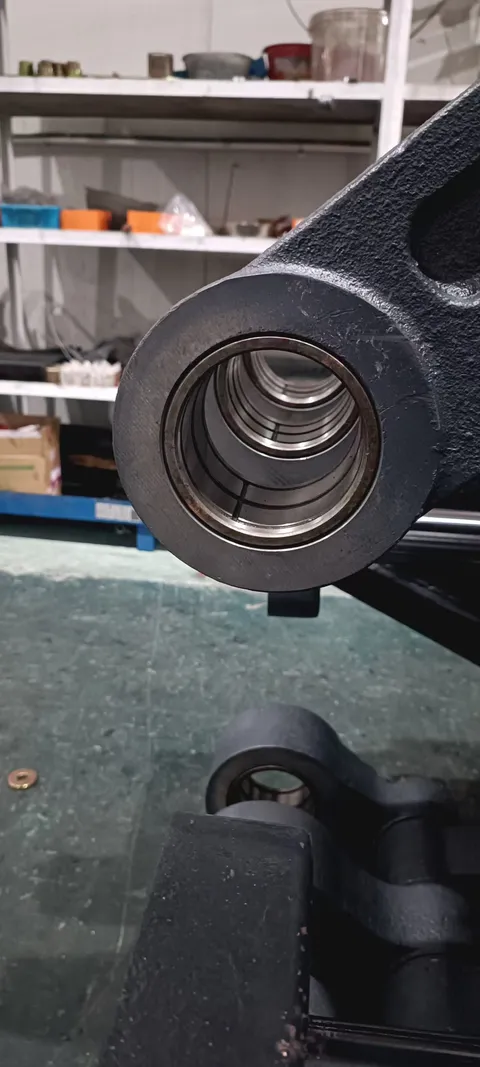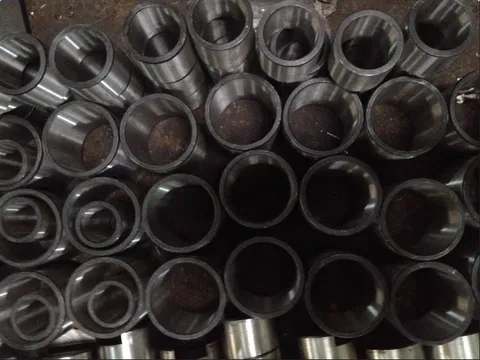
A toggle bushing, or toggle pin bushing, is the sleeve bearing pressed into each bore of the toggle links, in which a toggle pin turns. It is made of a softer bearing material than the pin, usually bronze or a self-lubricating composite, so that it wears instead of the pin and the link. Because it is the designed wear part of the toggle, it is the part replaced most often, and the first place to look when the clamp starts to knock or the clamping force becomes uneven.
Where the toggle bushings sit
The drawing marks two groups:
- Toggle bushings at the main pivots: the rear platen, the elbow between the links, and the moving platen. Parts lists call them toggle link bushings or toggle pin bushings.
- Connecting rod bushings in the short links that join the crosshead to the toggle links.
All of them work the same way; what differs is their size and position. They are not the same parts as the tie bar bushings, which guide the moving platen along the tie bars.
How a toggle bushing works
The bushing is pressed into the link bore with an interference fit, so it cannot turn in the bore. The toggle pin turns inside it with a small running clearance, filled with lubricant fed through the pin or the link into grooves or holes in the bushing bore.
The load is heavy and the motion is a short swing rather than a full rotation, with the highest load at lock-up. That is hard on any bearing, and it is why a toggle bushing depends on a regular supply of fresh lubricant from the lubrication system. As the bushing wears, the clearance grows. The play shows as a knock, and the linkage becomes slightly shorter, so the same mold height setting gives less clamping force.
Bronze or self-lubricating?
| Bronze bushing | Self-lubricating bushing | |
|---|---|---|
| Construction | Solid or oil-impregnated bronze, with grooves for the lubricant | Bronze with embedded solid lubricant such as graphite, or a composite with a low-friction lining |
| Lubrication | Depends on the oil or grease supply | Carries some lubricant itself and is less dependent on the supply |
| Suited to | Joints with a reliable centralized lubrication supply | Joints that are hard to lubricate, or where less lubricant is wanted near the mold |
The bushings we supply come in bronze or self-lubricating versions: toggle link bushings for Haitian MA and MA II, toggle pin bushings for Haitian MA, MA II and MA III, and connecting rod bushings for Haitian MA and MA II. Whichever type you fit, follow the machine manual on lubrication.
Signs of worn toggle bushings
- A knock or clunk at lock-up or when the mold breaks open.
- Play at the joints when the clamp is depressurized.
- Bronze-colored particles in the lubricant around a joint.
- Flash, or a lower clamping force at the same setting, and uneven tie bar stretch.
- A bushing that has moved sideways out of its bore or turns in it, a sign of a loose fit or a damaged bore.
- Cracked or broken pieces of bushing.
The main cause is lubrication failure. Dirt in the lubricant, the wrong lubricant, a clamping force set higher than needed, misalignment between the toggles and a poor fit at installation also shorten their life.
Checking bushing wear
The play at each joint can be measured in place with a dial indicator, as described in our toggle clamping system article. With the pin out, measure the bushing bore with a bore gauge in the direction of the load and at right angles to it: wear concentrates in the load direction, so a worn bore is oval. Compare the clearance with the pin diameter against the limit in the machine manual.
Replacing toggle bushings
- Remove the pin following the replacement steps on the toggle pins page.
- Press or pull the old bushing out with a puller or press and a stepped drift, taking care not to scratch the link bore.
- Clean the bore and measure it. A bore that is oval or scored must be repaired, for example by machining it oversize for an oversize bushing; ask the manufacturer or a machine shop.
- Measure the new bushing's outside diameter against the bore to confirm the interference fit.
- Press the new bushing in straight, with its lubrication hole lined up with the passage in the link or pin. Some fitters chill the bushing first so that it shrinks and goes in more easily.
- Pressing a bushing in closes its bore slightly. Check that the pin fits with the right running clearance, and follow the supplier's instructions if the bore must be finished after fitting.
- Assemble, then run the lubrication until fresh lubricant appears at the joint before moving the clamp.
Replace both bushings of a joint together, and the bushings in the matching positions of the upper and lower toggle, so that the two toggles stay alike. If the pin is scored or worn, replace it at the same time.
What to send for a replacement quote
- The machine brand, model, clamping force and serial number.
- The position of each bushing and the quantity.
- The outside diameter, inside diameter and length, and for a flanged bushing the flange diameter and thickness.
- The material (bronze or self-lubricating) and the pattern of grooves and holes, with photos.
- The OEM part number, if you have it.
See the toggle mechanism guide for how the bushings fit with the rest of the clamp.
Updated by the IMSPARES technical team.