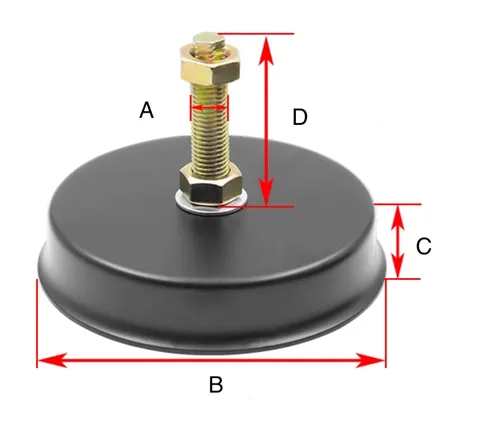
The injection molding machine leveling procedure sets the machine level along its length and across its width by adjusting the leveling bolts under the base, with every foot carrying load. You measure with a precision level on the reference surfaces the manufacturer names, adjust the bolts in small steps, check again in both directions, and lock the nuts. Do it at installation, after the machine has been moved, and whenever a check shows that the level has drifted. In the drawing, the leveling foot bolts you adjust are highlighted under the base.
Why leveling matters
A level, evenly supported base keeps the nozzle in line with the mold's sprue bushing, lets the injection unit carriage and the moving platen run straight on their guides, and spreads the wear in the tie bar bushings and slides evenly. A base frame that is twisted by uneven support affects all of these at once. The machine feet guide explains what the feet do.
What you need
- The manufacturer's installation manual and foundation drawing, with the reference surfaces, the tolerance and the jacking points.
- A precision machinist's level, or an electronic level, with the sensitivity the manual asks for. A builder's level is not sensitive enough.
- Wrenches to fit the leveling bolts and the lock nuts; you need two at a time to hold the bolt while tightening its nut.
- A hydraulic jack and solid blocks, if pads have to be fitted or a bolt changed.
- Clean cloths to wipe the reference surfaces and the level's base.
Before you start
- The floor must be clean, flat and sound concrete, as the foundation drawing specifies. New concrete must have cured for the time the instructions give. No slab joints or cracks should run under a foot.
- Fit all the leveling bolts and anti-vibration pads, with each pad centered under its bolt. Replace seized bolts and worn pads first: leveling a machine on bad feet does not last.
- Set the bolts near the middle of their adjustment range, so you can go up or down.
- Put the clamp and the injection unit in the positions the manual gives for leveling.
Leveling procedure
- Load every foot. Lower the machine onto the pads and turn each bolt down until it just takes weight.
- Clean the reference surfaces. Use the machined surfaces your manual names, for example the tie bars, the platen guideways or machined pads on the base. Never level on covers or sheet metal.
- Measure in both directions. Measure at the points the manual gives. Where it gives none, measure lengthwise at the clamp end, the middle and the injection end, and across the machine at the clamp end and the injection end. At each point, take a reading, turn the level end for end in the same place and read again: the average of the two cancels any error in the level itself.
- Adjust in small steps. Raise the low points rather than lowering the high ones. Turn the bolts a little at a time and work on pairs of feet. The base is stiff, so every adjustment changes the readings elsewhere.
- Check every foot. Try to turn each bolt: they should all resist about equally. A bolt that turns freely carries nothing, and the machine is resting on the others.
- Repeat the measuring and adjusting until both directions are within the manufacturer's tolerance and every foot carries load.
- Lock the nuts. Hold each bolt with one wrench and tighten its lock nut with the other, so the bolt does not turn. Then measure once more.
- Record the readings and where you measured, so the next check can be compared with them.
- Check again after a period of running, because new pads settle and a new floor can move, and then at planned maintenance stops.
Common mistakes
- Measuring on surfaces that are not machined, or not the ones the manual names.
- Leaving a foot unloaded. The level may read correctly while the frame is twisted.
- Lowering everything until the bolts run out of thread, so there is no adjustment left.
- Turning the bolt while tightening its lock nut, which undoes the setting.
- Using a level that is not sensitive enough, or one whose base is dirty.
- Leveling once at installation and never again.
After leveling
Once the machine is level, check the alignment that depends on it: the nozzle against the sprue bushing (see the nozzle page) and, if the clamp showed problems before, the platen parallelism. If they are still out after leveling, the cause lies in the machine itself, not in the feet.
Parts for the job
If bolts are seized or pads are worn, replace them before you level. See the leveling foot bolts and anti-vibration foot pads we supply. For a quote, send the machine model, the number of feet, the bolt thread size and length, and the pad type and diameter.
Updated by the IMSPARES technical team.