An auxiliary hydraulic cylinder is a smaller cylinder that works beside the main clamping cylinder of an injection molding machine. Depending on the machine, it adds force as a clamping booster, moves the platen quickly before the main cylinder takes over, or drives the ejector. It is built like the main cylinder, with a barrel, piston, seals and rod, so it wears and is serviced the same way. In the drawing, the auxiliary cylinder is the small cylinder below the main clamping cylinder.
Where auxiliary cylinders are used
The name covers several small cylinders, and which ones a machine has depends on its design:
- Clamping booster: a cylinder that adds its force to the main clamping cylinder during clamp-up.
- Fast-stroke (traverse) cylinders: on direct hydraulic clamps, small cylinders move the platen quickly over most of its travel, and the large clamping cylinder builds the force over the last short stroke.
- Ejector drive: a hydraulic cylinder behind the moving platen that pushes the ejector plate. See the ejector cylinder guide.
- Other movements: the carriage cylinders that move the injection unit forward and back, and core-pull cylinders on the mold, connected to the machine's core-pull valves.
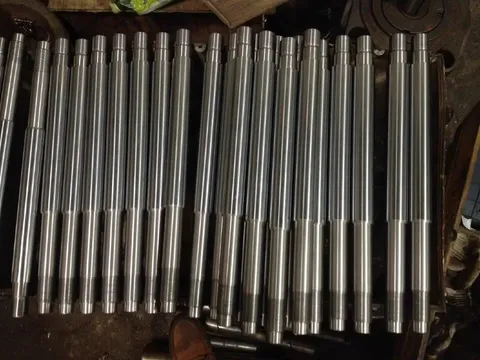
The auxiliary cylinder we supply is used as a secondary clamping booster or an auxiliary ejection drive, and is made of 45# steel.
How an auxiliary cylinder works
It is a double-acting cylinder: oil pumped into one end pushes the piston, and the oil on the other side returns to the tank. Its force is the oil pressure multiplied by the piston area, and its speed is the pump flow divided by that area. A small bore therefore gives less force but more speed for the same flow. That is why machines combine small, fast cylinders with a large, slow, strong one: the small cylinders do the long movements and the large one does the clamping.
The oil reaches the auxiliary cylinder through its own valve in the valve manifold, so a fault in the cylinder and a fault in its valve can look the same.
Signs of a worn auxiliary cylinder
- Oil on the rod or dripping from the front head: worn rod seals and wiper.
- Slow or jerky movement, especially when it starts.
- The movement drifts when the valve is closed, or the ejector does not stay back.
- Weak force: the ejector struggles to push the part off, or clamp-up takes longer.
- Knocking at the end of the stroke, or loose mounting bolts.
- Wear on one side of the rod, a sign that the cylinder is misaligned with what it pushes.
Why auxiliary cylinders wear
The causes are the same as for the main cylinder: dirty or hot oil, a damaged rod, worn piston seals, and pressure peaks from fast valve switching. Ejector cylinders sit behind the moving platen, close to the mold area, where heat, water and plastic dust reach the rod, and they stroke several times per cycle when multiple ejection is set. Misalignment between the cylinder and the part it drives adds side load that wears the guide ring and the rod seals.
Checking and servicing
- Make the machine safe: stop the pump, lock out the power and release all pressure, including the accumulator if fitted.
- Inspect the rod for scratches and pitting, and the mounting, clevis or flange and rod end for wear and play.
- Check the alignment of the cylinder with the part it drives.
- If the movement drifts or lacks force, test for piston seal bypass as described in piston seals, and check its valve.
- Reseal the cylinder following replacing cylinder seals. Being smaller, it can usually be removed and resealed on the bench.
- Replace the whole cylinder if the bore is scored or the rod is bent.
What to send for a replacement quote
- The machine brand, model and serial number.
- What the cylinder does: clamping booster, fast stroke, ejector or another movement.
- The bore, rod diameter and stroke.
- The retracted length between the mounting points, the mounting type and its dimensions.
- The rod end thread, and the size and position of the oil ports.
- Photos of the cylinder and its nameplate.
Request a quote, and see the clamping cylinder guide for how the auxiliary cylinder works with the main one.
Updated by the IMSPARES technical team.